Why Sunscreen Matters: Protect Your Skin from Spots and Ageing, Summer and Winter
Skin ageing was 24% lower in people who used sunscreen daily. The difference between UVA and UVB, the right amount and why protection matters in winter too.
If you think "sunscreen is only for summer and the beach", if you use expensive serums for dark spots and wrinkles but skip sunscreen, or if you say "I put on SPF 50, I'm protected all day", this article is for you. We answered the questions about sun protection that the Devida skincare team hears most often. The answers are based on large randomised studies, expert reviews and World Health Organization information.
This article does not replace a medical diagnosis. If you notice a mole that is new, growing, changing in colour or shape, or bleeding, or a sore that doesn't heal, see a dermatologist without delay.
What does the sun do to our skin?
Question: What is the difference between UVA and UVB?
Answer: Sunlight contains two types of ultraviolet rays that matter for the skin:
| Ray | Effect on skin | Characteristics | On the label |
|---|---|---|---|
| UVB | Sunburn, redness; contributes to skin cancer risk | Strongest at midday in summer; largely blocked by glass | SPF value |
| UVA | Premature ageing, wrinkles, dark spots; contributes to skin cancer risk | Present all year and all day; can pass through clouds and glass | "UVA" logo, PA+ or "broad spectrum" |
| Visible light (blue-violet) | Persistent dark spots, especially on medium and darker skin | The visible part of sunlight | Tinted sunscreens with iron oxides |
Question: Does sunscreen really slow down ageing?
Answer: Yes, and this was shown in a large randomised study. In the Australian town of Nambour, adults were divided into a group using sunscreen every day and a group using it whenever they chose. After four and a half years, skin ageing measured on the backs of the hands was 24% lower in the daily sunscreen group than in the other group (Hughes et al., Ann Intern Med 2013).
Question: Does it help prevent skin cancer?
Answer: In the long-term follow-up of the same Nambour study, 10 years after the trial ended there were 11 new melanomas in the daily sunscreen group and 22 in the other group; the difference was clearer for invasive melanoma (3 versus 11). The authors concluded that melanoma may be preventable with regular sunscreen use in adults (Green et al., J Clin Oncol 2011). We should note that the difference for overall melanoma was just above the statistical threshold; sunscreen alone does not eliminate risk, and shade, hats and avoiding the sun at peak hours are also needed.
Reading the label correctly
Question: Does SPF 50 mean twice the protection of SPF 30?
Answer: No. SPF shows protection against UVB in the laboratory. When applied in the right amount, SPF 30 blocks about 97% of UVB rays and SPF 50 about 98%. The difference looks small, but because most people apply too little in real life, a higher SPF provides a safety margin.
Question: Why does "the right amount" matter so much?
Answer: The SPF on the label is measured by applying 2 mg of cream per square centimetre. Real-life observations show that people apply only half of that or less (about 0.4–1 mg per square centimetre), which drops real protection far below the label value. The authors note that reapplying early and using a high SPF can partly close this gap (Petersen and Wulf, Photodermatol Photoimmunol Photomed 2014).
In winter, on cloudy days and indoors
Question: Is sunscreen needed in winter?
Answer: Yes. UVB decreases in winter, but UVA is present all year and can pass through clouds. The World Health Organization recommends sun protection when the UV index is 3 or above and stresses that the amount of UV passing through clouds should not be underestimated (WHO, Ultraviolet radiation). In snowy areas, fresh snow reflects a very large share of UV rays on a sunny day, markedly increasing exposure (Better Health Channel).
Question: Is it needed at home or in the office, next to a window?
Answer: Window glass blocks most UVB, but a significant part of UVA can pass through. If you sit next to a window that gets sun all day or drive for long periods, applying sunscreen makes sense, especially for spot-prone skin.
Question: Doesn't darker skin not need sunscreen?
Answer: It does. Darker skin is more resistant to burning, but sun and visible light more easily cause persistent dark spots and uneven tone in this skin. In melasma patients, an iron-oxide sunscreen has been shown to give greater improvement in pigmentation than a UV-only sunscreen (Castanedo-Cázares et al., 2014).
Common myths
Question: My make-up has SPF. Is that enough?
Answer: Usually not. We don't apply foundation or powder thickly enough (about half a teaspoon for the face) to get the protection on the label. Apply a separate sunscreen under your make-up and see the SPF in make-up as extra reassurance.
Question: Does water-resistant sunscreen protect all day?
Answer: No. "Water-resistant" means that part of the protection remains after a certain time of swimming or sweating. Towel drying, sweat and friction remove sunscreen; always reapply after swimming and sweating.
Question: Does sunscreen cause vitamin D deficiency?
Answer: Because in real life no one applies sunscreen perfectly and at full thickness, marked vitamin D deficiency is not commonly seen as a problem in sunscreen users. If you are worried about your vitamin D level, rather than staying unprotected in the sun, check your blood level and need for supplements with your doctor.
Step-by-step: how to use it correctly
Question: How and how much sunscreen should I apply?
- Amount: For face and neck, use two lines of cream along the length of your index and middle fingers.
- Timing: As the last step of your morning routine, about 15 minutes before going out.
- Forgotten areas: Ears, sides of the neck, hairline, around the eyelids and the backs of the hands.
- Reapplication: Every 2 hours outdoors, and immediately after swimming, sweating or towel drying.
- Support: Shade at midday, a wide-brimmed hat and sunglasses with UV protection.
Question: Where does sunscreen go in my routine?
| Step | Morning |
|---|---|
| 1 | Gentle cleanser |
| 2 | Antioxidant serum: vitamin C (e.g. Devida Citréa Series A240) — supports sunscreen, does not replace it |
| 3 | Hydrating serum or moisturiser (e.g. Devida Aura Series A250) |
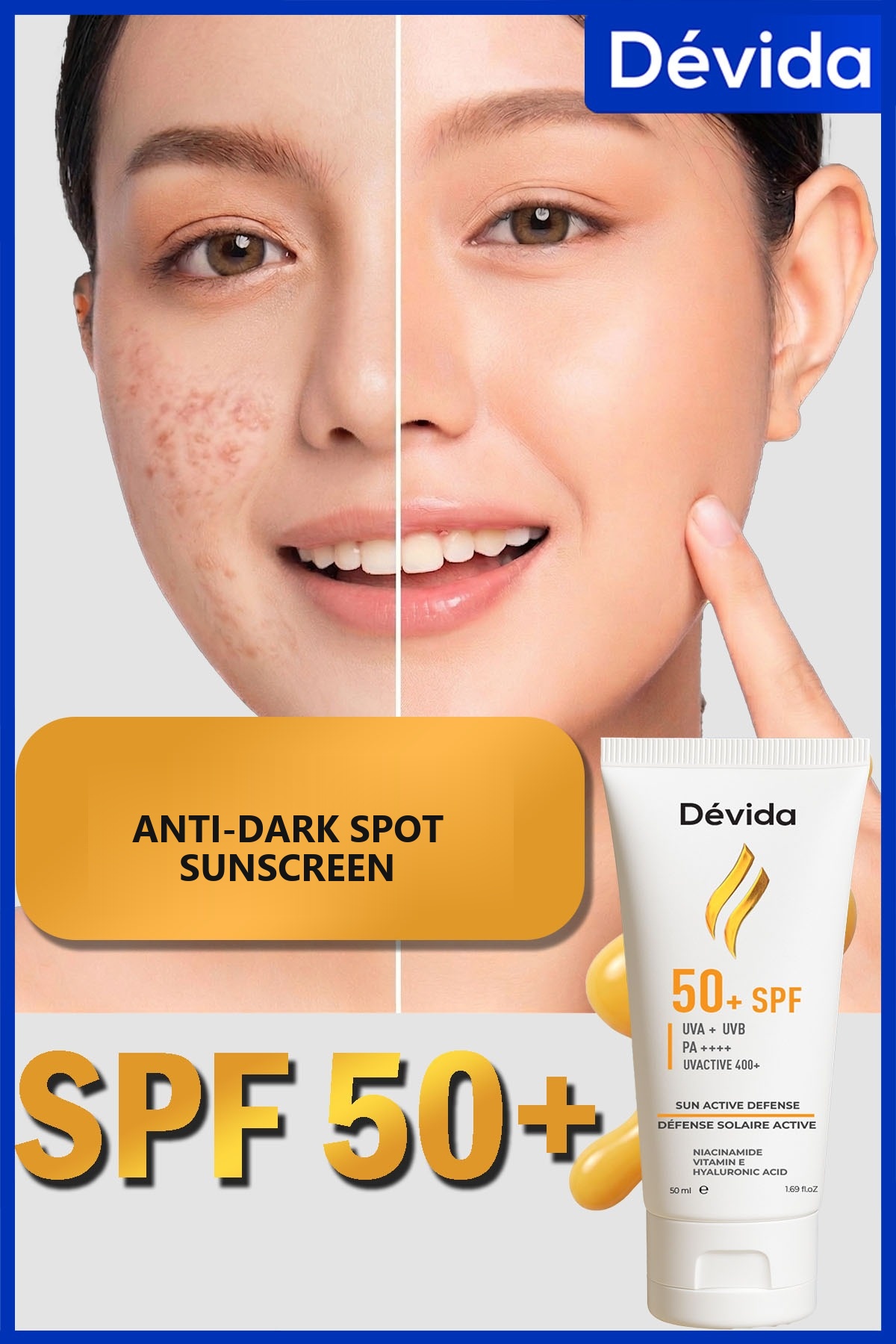
| 4 | Broad-spectrum sunscreen SPF 50 (e.g. Devida Sunveil Series G100 — suitable under make-up, light and oil-free) |
| 5 | Make-up if you wish |
If you use products that make the skin more sensitive to the sun, such as retinol, glycolic or salicylic acid, sunscreen is not optional but essential. Check each product's instructions and ingredient list on its packaging.
Who should be careful, and when should you see a doctor?
Question: Can sunscreen be used on babies?
Answer: Babies under 6 months should not be taken into direct sun; protect them with shade and clothing. For older children, choose child-appropriate products with your doctor's advice.
Question: Does sunscreen cause breakouts?
Answer: Some heavy, oily formulas can clog pores in acne-prone skin. For this skin, choose light, oil-free formulas labelled "non-comedogenic", and remove sunscreen in the evening with a gentle double cleanse.
Question: When should I see a doctor?
- A mole that is new, growing, asymmetrical, has irregular edges or more than one colour.
- A sore that bleeds, crusts and doesn't heal within a few weeks.
- An unusual rash, itching or blisters after sun exposure (possible sun allergy or medication-related light sensitivity).
- Severe sunburn: widespread blisters, fever, chills or dizziness.
Final word
Question: If you remember just one thing from this article, what should it be?
Answer: The most effective anti-ageing and anti-spot product is the broad-spectrum sunscreen you apply in sufficient amount every morning. Make it the last step of your routine in summer and winter, on cloudy and sunny days alike; and don't forget to reapply outdoors and to add shade and a hat.
Devida wishes you healthy and happy days.
Sources
- Hughes MCB et al. Sunscreen and prevention of skin aging: a randomized trial — Ann Intern Med, 2013
- Green AC et al. Reduced melanoma after regular sunscreen use: randomized trial follow-up — J Clin Oncol, 2011
- Petersen B, Wulf HC. Application of sunscreen − theory and reality — Photodermatol Photoimmunol Photomed, 2014
- World Health Organization. Ultraviolet radiation — fact sheet
- Better Health Channel (Victoria State Government). Sun protection at the snow
- Castanedo-Cázares JP et al. Near-visible light and UV photoprotection in the treatment of melasma — Photodermatol Photoimmunol Photomed, 2014