Minimising Pores and Clearing Blackheads: A Guide to Glycolic Acid (AHA/BHA)
A blackhead isn't dirt but a plug. An evidence-based routine with salicylic acid, glycolic acid and niacinamide to reduce the look of pores.
If the blackheads on your nose don't go away no matter how much you squeeze, your T-zone shines by midday and your pores look more visible in the mirror every year, this article is for you. We answered the questions about pores and blackheads that the Devida skincare team hears most often. The answers are based on published reviews, clinical studies and the American Academy of Dermatology's 2024 acne guideline.
This article does not replace a medical diagnosis. If you have inflamed, painful, deep breakouts or your spots leave scars, cosmetic care may not be enough; see a dermatologist.
What are pores and blackheads?
Question: What exactly is a pore?
Answer: The openings we see on the face as "pores" are the mouths of hair follicles and their attached oil (sebum) glands opening onto the skin. Pore size depends largely on genetics, oil production and age. When oil production is high and, with age, the tissue around the pore loses elasticity, pores look more visible.
Question: Is a blackhead dirt?
Answer: No. A blackhead (open comedone) is a plug of sebum and dead skin cells that builds up at the opening of the pore. Its colour comes not from dirt but from the plug oxidising on contact with air. That is why scrubbing or harsh cleansers don't remove it; you need to target the process that forms the plug.
| Type | Appearance | Why does it form? |
|---|---|---|
| Blackhead (open comedone) | Dark dot at the pore opening | Plug of sebum + dead cells, oxidised by air |
| Whitehead (closed comedone) | Small skin-coloured or white bump | Plug with a closed opening |
| Sebaceous filament | Regularly spaced grey-light dots on the nose | Normal oil flow; can be reduced, not eliminated |
| Inflamed spot | Red, painful bump or pus | Blockage + bacteria + inflammation; may need medical treatment |
Which ingredients work?
Question: Why is salicylic acid (BHA) so popular?
Answer: Because salicylic acid is oil-soluble, it can reach inside the pore, where the sebum is. It loosens the proteins that hold cells together, helping the plug dissolve and the surface renew (Arif, Clin Cosmet Investig Dermatol 2015). The American Academy of Dermatology's 2024 acne guideline gives salicylic acid a conditional recommendation; in other words, it may help, but its evidence is not as strong as for benzoyl peroxide and retinoids (Reynolds et al., J Am Acad Dermatol 2024).
Question: What does glycolic acid (AHA) do?
Answer: Glycolic acid is a water-soluble alpha hydroxy acid; by helping dead cells on the surface shed, it smooths texture and helps reduce blockages. In-clinic glycolic acid peels are used for acne, acne scars, pigmentation and oiliness; their depth depends on the acid concentration, number of coats and contact time (Sharad, Clin Cosmet Investig Dermatol 2013). Serums used at home are much weaker than these clinical peels.
Question: Does niacinamide affect oiliness?
Answer: In one study, using a moisturiser with 2% niacinamide for 4 weeks reduced sebum excretion rate in Japanese participants and surface oil levels in Caucasian participants compared with placebo (Draelos et al., J Cosmet Laser Ther 2006). The effect is moderate, but because niacinamide is well tolerated, it helps balance a routine that includes acids.
| Ingredient | What does it do? | Evidence / note |
|---|---|---|
| Salicylic acid (BHA) | Reaches inside the pore, dissolves the plug | AAD 2024: conditional recommendation |
| Glycolic acid (AHA) | Renews the surface, smooths texture | Well documented in clinical peels; low strength at home |
| Retinoids | Normalise cell turnover, reduce new plug formation | AAD 2024: strong recommendation (topical retinoids) |
| Benzoyl peroxide | Reduces acne bacteria | AAD 2024: strong recommendation; may bleach fabrics |
| Niacinamide | Moderately reduces oiliness, calms redness | Small studies |
| Zinc, witch hazel (hamamelis) | Used to balance the look of oil and shine | Independent clinical evidence limited |
Common myths
Question: Do pores open and close? Does steam open them and cold water close them?
Answer: No. Pores have no doors; hot steam doesn't "open" them and cold water doesn't "close" them. Heat only temporarily softens surface sebum. The appearance of pores improves by reducing plugs, balancing oil and protecting the surrounding tissue from the sun.
Question: Is it OK to squeeze blackheads or use nose strips?
Answer: Squeezing can damage the pore wall and leave inflammation, scars and dark marks. Nose strips pull out the top of the plug and give instant relief, but the plug re-forms within days and frequent use can irritate the skin. The lasting solution is regular chemical exfoliation.
Question: Shouldn't oily skin skip moisturiser?
Answer: No, it should use one. Acids and drying products can weaken the barrier, and skin with a damaged barrier becomes more sensitive and uncomfortable. A light, oil-free, non-comedogenic moisturiser is necessary for oily skin too.
Question: The more acid, the cleaner the pores?
Answer: No. Layering several acids, retinoids and peels on the same evening leads to irritation, redness and, especially on darker skin, new dark marks. Using one active product consistently is more effective than using many products irregularly.
Step-by-step: how to use them correctly
Question: What should a routine for blackheads and pores look like?
| Step | Morning | Evening |
|---|---|---|
| 1 | Gentle, low-foaming cleanser | Gentle cleanser (double cleanse if wearing make-up and sunscreen) |
| 2 | Light serum with niacinamide or vitamin C (e.g. Devida Citréa Series A240) | BHA/AHA serum, starting 3–4 evenings a week (e.g. Devida Elixir Series A260 or Vivo Series A210, 2–3 drops on clean, completely dry skin) |
| 3 | Oil-free moisturiser or hydrating serum (e.g. Devida Aura Series A250) | On evenings without acids, a retinoid (e.g. Devida Xella Series A220) or hydration only |
| 4 | Sunscreen SPF 50 (e.g. Devida Sunveil Series G100, light and oil-free) | Light moisturiser |
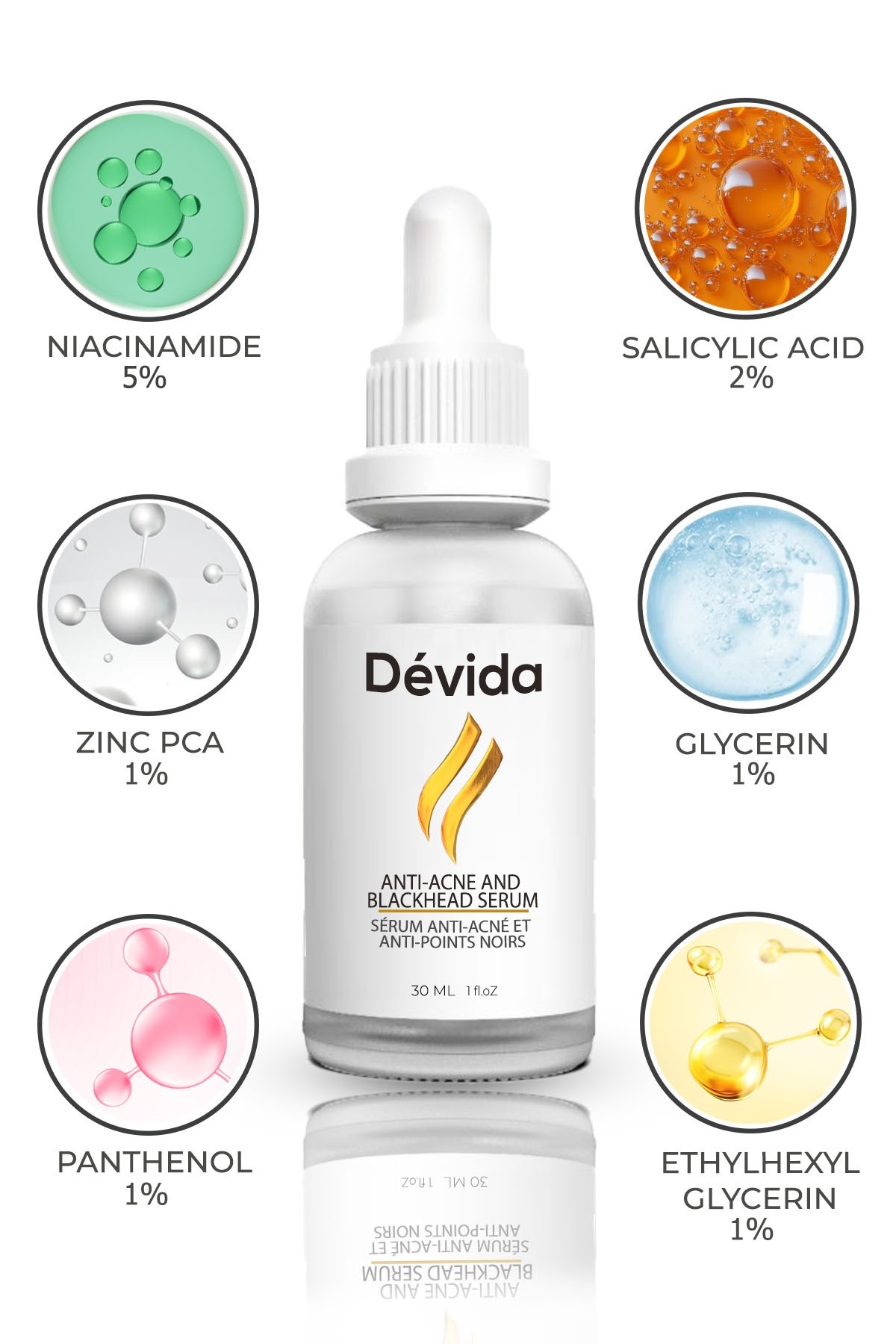
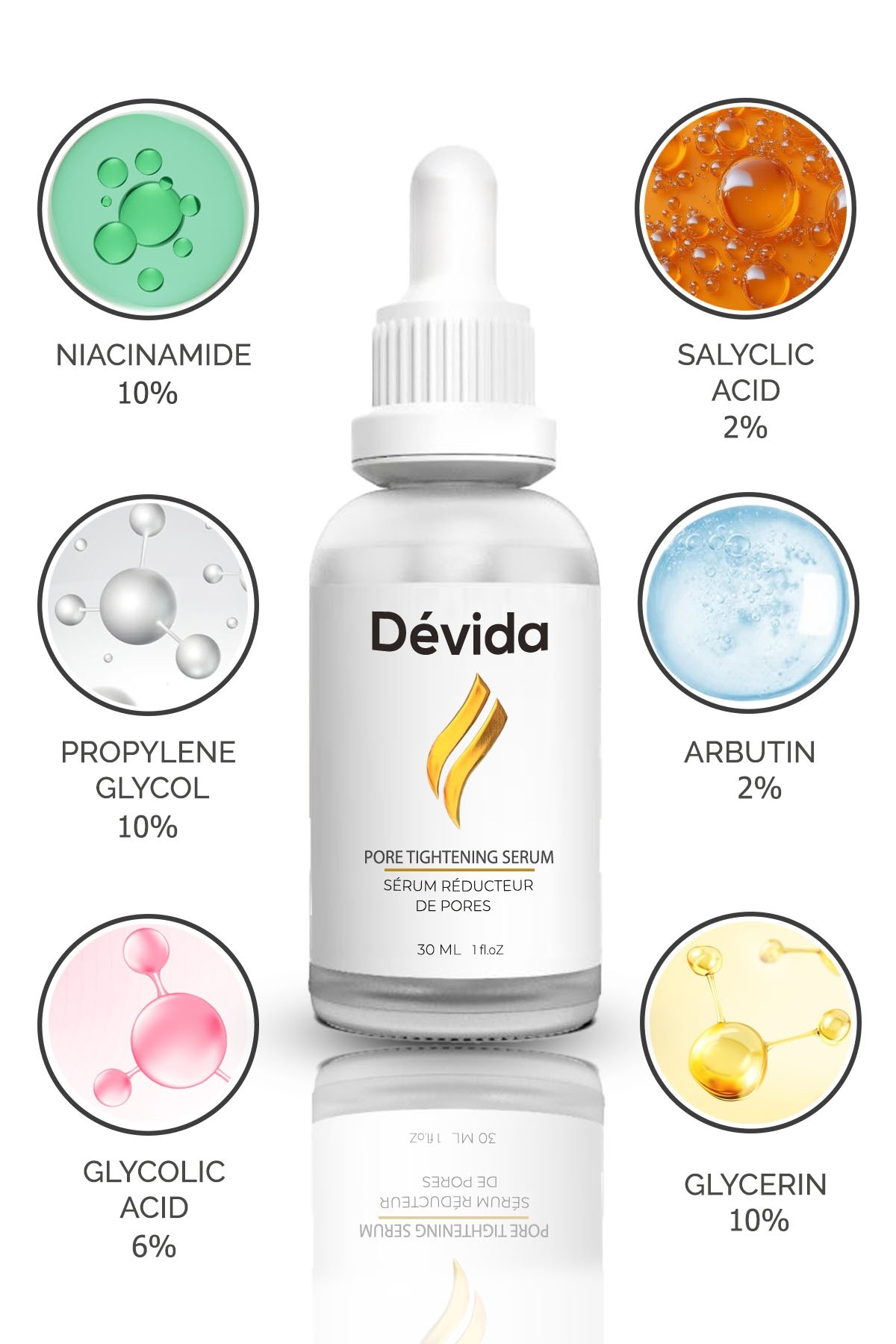
According to the packaging, Devida Elixir Series A260 contains salicylic acid (BHA), glycolic acid (AHA), niacinamide, zinc PCA, hamamelis, panthenol, allantoin, glycerin and sodium hyaluronate. Devida Vivo Series A210 contains salicylic acid, niacinamide, zinc, sodium hyaluronate, panthenol and glycine soja; it is applied to the forehead, nose and chin, avoiding the eye area. Percentages are not stated. Do not layer an acid serum and a retinoid on the same evening; split them across different evenings.
Question: Why is sunscreen essential when using acids?
Answer: Because acids remove dead cells from the surface, the skin becomes more sensitive to the sun. And when irritation and sun combine, post-acne dark marks last longer. Use a broad-spectrum sunscreen every morning.
Question: When will I see results?
Answer: Smoother texture and less shine are usually noticed in 2–4 weeks, and a clear reduction in blackheads in 6–8 weeks. The look of pores improves, but pores don't "disappear" completely; when you stop the routine, plugs form again.
Who should be careful, and when should you see a doctor?
Question: Can salicylic acid be used during pregnancy?
Answer: Check with your doctor about low-concentration cosmetic products used on the face; retinoids are not used in pregnancy. In this period you can discuss options such as azelaic acid and niacinamide with your doctor.
Question: I have sensitive skin and acids sting.
Answer: Start with 2 evenings a week, apply the product to dry skin and use a moisturiser on top. If stinging and redness continue, take a break and repair your barrier.
Question: When should I see a doctor?
- You have deep, painful, inflamed spots or cysts.
- Your spots leave pitted scars or dark marks.
- No improvement after 8–12 weeks of consistent care.
- Acne comes with irregular periods, excessive hair growth or sudden weight changes (a hormonal assessment may be needed).
Final word
Question: If you remember just one thing from this article, what should it be?
Answer: A blackhead isn't dirt but a plug; it's cleared by dissolving, not scrubbing. One BHA/AHA product used consistently, a light moisturiser and sunscreen every morning give far more lasting results than squeezing, steam and harsh cleansers.
Devida wishes you healthy and happy days.
Sources
- Arif T. Salicylic acid as a peeling agent: a comprehensive review — Clin Cosmet Investig Dermatol, 2015
- Sharad J. Glycolic acid peel therapy – a current review — Clin Cosmet Investig Dermatol, 2013
- Draelos ZD, Matsubara A, Smiles K. The effect of 2% niacinamide on facial sebum production — J Cosmet Laser Ther, 2006
- Reynolds RV et al. Guidelines of care for the management of acne vulgaris — J Am Acad Dermatol, 2024