Hyaluronic Acid from A to Z: What Is It and What Does It Do?
The chemistry and origin of hyaluronic acid, its forms on the label and molecular weight; the difference between serums, fillers and supplements, and tips for choosing a product.
You see hyaluronic acid on the label of almost every serum, but if you haven't found clear answers to "what exactly is it, where does it come from, is it the same as the hyaluronic acid in fillers, and which product should I choose?", this article is for you. Unlike our routine article for dry and dehydrated skin, here we cover the ingredient itself from A to Z. The answers are based on published scientific reviews and clinical studies.
This article does not replace a medical diagnosis. Fillers, injections or oral supplements require a doctor's assessment.
What is hyaluronic acid?
Question: What is hyaluronic acid chemically?
Answer: Hyaluronic acid (HA) is a long chain made of two simple sugar units (glucuronic acid and N-acetylglucosamine) repeated one after the other; scientifically, it is a glycosaminoglycan. Its name comes from its first isolation in 1934 from the clear gel inside the eye (Greek "hyalos": glass). The length of the chain varies a lot, which is why we speak of "low" and "high molecular weight" hyaluronic acid.
Question: Where is it found in the body, and what does it do?
Answer: It is found in joint fluid, the eye, connective tissue and, above all, the skin. In the skin it binds water, giving tissue volume and moisture, creates a flexible environment between cells and takes part in wound healing. With age and sun damage, the amount and structure of hyaluronic acid in the skin change, which is associated with moisture loss (Papakonstantinou et al., Dermato-Endocrinology 2012).
Question: Where does cosmetic hyaluronic acid come from?
Answer: In the past it was obtained from animal sources such as rooster combs. Today most hyaluronic acid used in cosmetics is produced by bacteria in a controlled environment (fermentation). If you're curious about the source in your product, you can ask the manufacturer; vegan-labelled products usually state this.
Names on the label and molecular weight
Question: Under which names does it appear on the label?
| INCI name | What it means | Behaviour on the skin |
|---|---|---|
| Hyaluronic acid | Acid form | Usually converts to the salt form in the formula |
| Sodium hyaluronate | Sodium salt; the most common, highly water-soluble form | Surface film or passage into upper layers, depending on size |
| Hydrolyzed hyaluronic acid | HA broken into small fragments, low molecular weight | Can pass into the stratum corneum |
| Sodium hyaluronate crosspolymer | HA with chains linked together | A longer-lasting, flexible surface film |
| Sodium acetylated hyaluronate | Chemically modified HA | Developed for longer-lasting hydration; independent data limited |
Question: Why does molecular weight matter?
Answer: Because it determines how far it penetrates the skin. In a study on human skin, hyaluronic acid between 20 and 300 kDa could pass into the stratum corneum, while 1000–1400 kDa stayed on the surface (Essendoubi et al., Skin Res Technol 2016). All the 0.1% HA creams of different molecular weights applied around the eyes for 60 days increased hydration and elasticity, while a marked reduction in wrinkle depth was associated with the low-molecular-weight forms (Pavicic et al., J Drugs Dermatol 2011). In practice, good formulas combine different sizes.
Cream, filler and supplement: the same thing?
Question: Is the hyaluronic acid in fillers the same as in serums?
Answer: No. Hyaluronic acid in fillers is a heavily cross-linked gel designed to stay in the tissue for a long time, and it is injected into the skin by a doctor to fill volume loss. Hyaluronic acid in a serum holds moisture on the surface and in the upper layers of the skin. A serum does not replace a filler; and a filler is a medical procedure that should only be performed by a doctor.
| Use | How it is applied | What it does |
|---|---|---|
| Serum / cream | Applied to the skin | Hydration on the surface and upper layers; plumper, smoother look |
| Filler | Injected by a doctor | Fills volume loss; a medical procedure |
| Oral supplement | Capsule, drink | Studies on skin effects are limited; consult your doctor |
What does the science say?
Question: Has the effect of a hyaluronic acid serum been measured?
Answer: Yes. In a study in which 40 women aged 30–65 with signs of sun damage used a hyaluronic acid serum twice daily with sunscreen, skin hydration measured with a device increased by about 55%, with no increase in irritation markers (Draelos et al., Dermatol Ther 2021). The study was supported by the product's manufacturer.
Common myths
Question: Since hyaluronic acid is an "acid", does it peel the skin?
Answer: No. Despite "acid" in its name, it has no peeling effect like glycolic or salicylic acid; it doesn't exfoliate, it hydrates. Sensitive skin generally tolerates it well.
Question: Is "it holds 1000 times its weight in water" true?
Answer: This is a marketing phrase based on laboratory water-binding capacity; there is no measurement showing that a serum applied to the skin has such an effect in the skin.
Question: Should only dry skin use it?
Answer: No. Oily skin can also lose water; a light, oil-free hyaluronic acid serum offers more comfortable hydration for oily skin than heavy creams.
What to look for when choosing a product
Question: How do I choose a good hyaluronic acid product?
- Position on the ingredient list: Ingredients are listed from highest to lowest concentration; hyaluronic acid forms in the upper-middle part of the list is a good sign.
- More than one form: Different molecular sizes provide hydration both on the surface and in the upper layers.
- Supporting ingredients: Humectants such as glycerin, panthenol and betaine, and a moisturiser on top.
- Packaging and fragrance: For sensitive skin, formulas low in fragrance and alcohol cause less irritation.
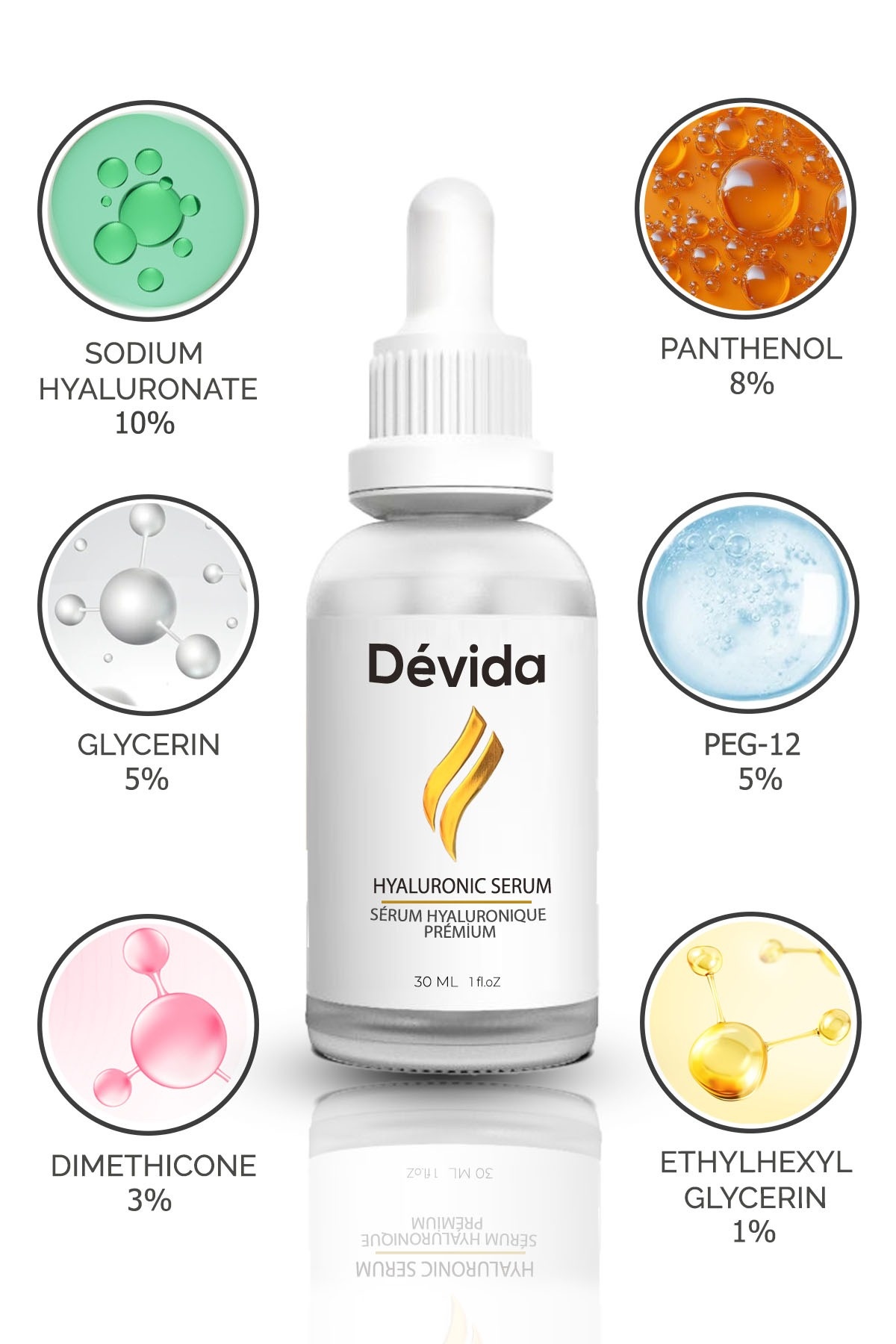
Question: Which Devida product contains hyaluronic acid, and what's in it?
Answer: Ingredients listed on the packaging of Devida Aura Series A250: sodium hyaluronate, hydrolyzed hyaluronic acid, sodium hyaluronate crosspolymer, panthenol, glycine soja, betaine and allantoin; percentages are not stated. So the three different hyaluronic acid forms described above are combined. Use: 2–3 drops, once or twice a day, morning and/or evening; once a day for dry or sensitive skin; for very sensitive skin, starting every other day is recommended. Hyaluronic acid can be used together with vitamin C, niacinamide, retinol and acids, and helps balance the dryness these products can cause.
Who should be careful?
Question: Can it cause allergies?
Answer: Allergy to hyaluronic acid itself is rare; reactions usually come from fragrance, preservatives or another ingredient in the formula. Before starting a new product, do a patch test behind the ear or under the jaw.
Question: Can it be used during pregnancy?
Answer: Hyaluronic acid applied to the skin is generally well tolerated, as it is a molecule already present in the body; still, show the full ingredient list of the product to your doctor.
Final word
Question: If you remember just one thing from this article, what should it be?
Answer: Hyaluronic acid is the skin's own moisture molecule, and when applied to the skin it does its best work on the surface and in the upper layers. A serum combining different molecular sizes, used with a moisturiser on top and sunscreen every morning, provides realistic and consistent hydration; it does not, however, replace fillers or medical procedures.
Devida wishes you healthy and happy days.
Sources
- Papakonstantinou E, Roth M, Karakiulakis G. Hyaluronic acid: A key molecule in skin aging — Dermato-Endocrinology, 2012
- Essendoubi M et al. Human skin penetration of hyaluronic acid of different molecular weights as probed by Raman spectroscopy — Skin Res Technol, 2016
- Pavicic T et al. Efficacy of cream-based novel formulations of hyaluronic acid of different molecular weights in anti-wrinkle treatment — J Drugs Dermatol, 2011
- Draelos ZD et al. Efficacy Evaluation of a Topical Hyaluronic Acid Serum in Facial Photoaging — Dermatol Ther (Heidelb), 2021